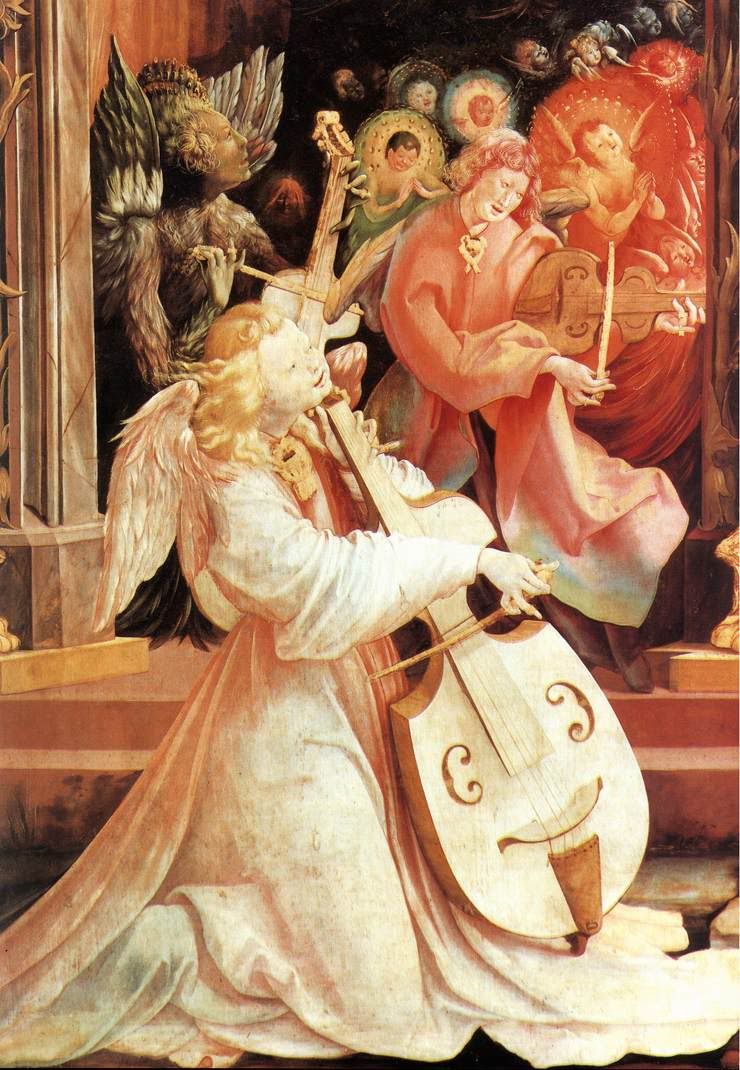
 My favorite piece of artwork is the Isenheim Altarpiece. When we were in Germany for a wedding about 5 years ago I insisted on driving a heart pounding, 6 hour Autobahn death ride detour to see it in person in Colmar, France. Art history books and these pixelated images don’t do justice to its breathtaking scale and its searing, bright colors. When I finally saw it, I stood before it, swaying and slack jawed, for hours. The polyptych depicts the life of Christ and the temptation of St Anthony. It was commissioned in 1515 for an Anotine monastery that also served as a skin ailment hospital. Many of the patients treated there suffered from St Anthony’s Fire, also known as ergotism, an affliction brought about from eating bread made from rye contaminated with the fungus ergot. In its latter and most serious stages, ergotism could cause severe hallucinations and open sores which quickly turned gangrenous. Amputation was often the only treatment, and its victims suffered excruciatingly. The work was to remind them of the life of Christ and how he, too, suffered but was resurrected in pain free glory. The beauty was to take the patients’ mind off their agony as they writhed on their pallets. The paintings, which range from horrifying grotesque to exquisitely beautiful, are almost hallucinatory, like a fever vision.
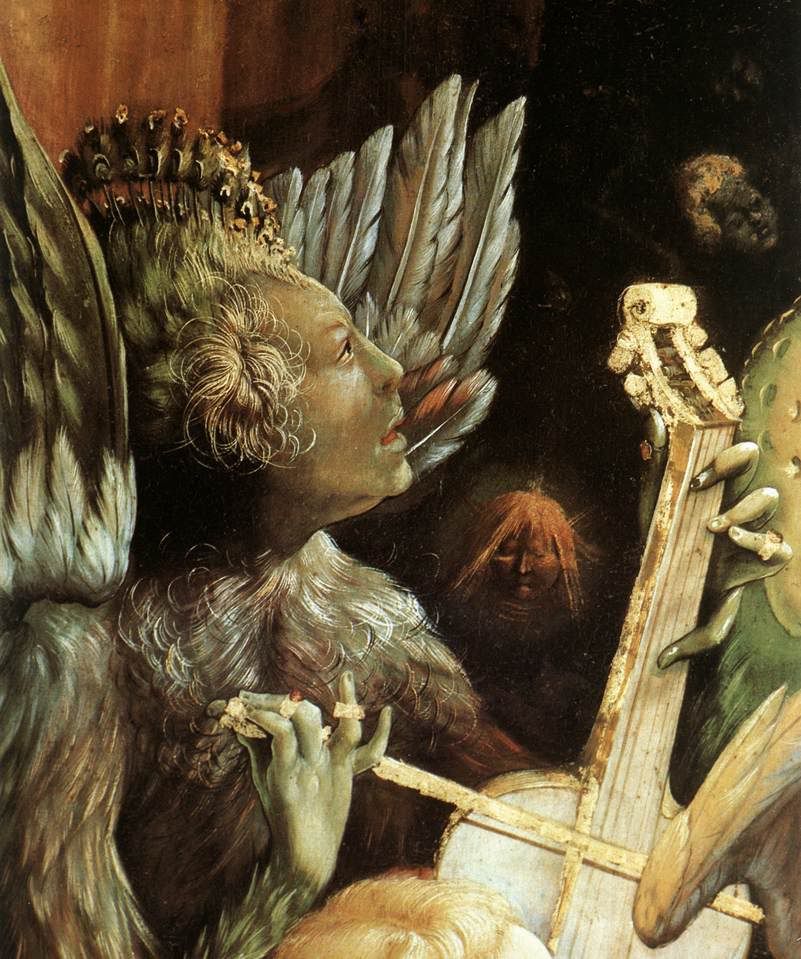 The most intriguing panel depicts a concert of angels, who have all struck up a chord to celebrate the birth of Christ. But who is this odd, enigmatic feathered figure with the strange green hue? And why is he looking off quizzically in the wrong direction, away from the Nativity (on the panel to the right), his mouth slightly open in bafflement? Art historians believe he is the devil, the beautiful fallen angel. He is missing out on the action because, through his own actions, he has been cut off from the glory of God forever, and doesn’t recognize Christ because he has taken human form. The comb on his head is a peacock’s comb, signifying pride. Why he is feathered is anyone’s guess, but representing the devil in this fashion was unprecedented. I’m also intrigued by his strange, spindly, bejeweled fingers at the bow and on the strings, which play the instrument at physiologically impossible angles. He was the most beautiful of angels but now that he is corrupted he has turned a sickly shade of green exactly that of gangrene. He also seems to be developing a wattle.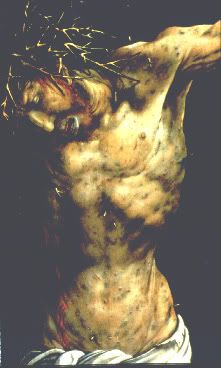
Gangrene Christ
The altarpiece's most famous panel is the one depicting the crucifixion of Christ, and what a nauseating, awful vision it is. Christ’s sore encrusted, scourged limbs are twisted in agony and his shoulders stretching and dislocating from the weight of his body. This portrayal pulls no punches. Take that, Mel Gibson! I think the message to those afflicted with ergotism is: So, you think you're in agony with your paltry skin disease? Well check out the son of God here! He was crucified, and all for your sins! So suck it up.
 Psychedelic Jesus Christ, Super Star!
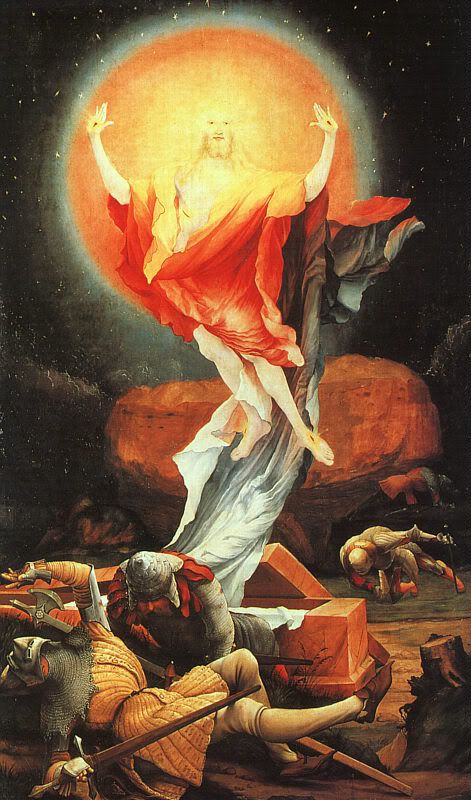
 Here is the Resurrection panel and behold Jesus, unfettered and floating, healthy and golden, his skin alabaster and perfect except for nail punctures. He has felled and scattered all of the soldiers with his explosive radiance. I can’t believe how psychedelic the colors are in this panel. It looks like something out of Heavy Metal. This is the promise of the Resurrection, that the sufferer, like Jesus, will one day be restored clean and whole.
The Isenheim altarpiece has a fascinating history. It sank into obscurity in the 18th century, was nearly destroyed by fire, escaped the whitewash brush during the Reformation, was dismembered and hidden away during the Reign of Terror, nearly destroyed by Napolean and almost stolen by art hoarding Nazis. It now resides in Colmar, France at the Unterlinden Museum.


 The manner of living throughout the Middle Ages made general lousiness inevitable. In England, in the 12th and 13th centuries, the houses of the poor were mere hovels, often with only a hole in the roof to let out the smoke of the central fire; and in cold weather the families were huddled together at night without changing the simple garments – usually a single shift – which they wore in the daytime. Washing was practically out of the question, and the better classes – not very much more comfortable in their badly heated domiciles – wore a great many clothes, which they rarely changed. MacArthur’s story of
  I noticed that I was getting a ton of traffic from people searching for the translated lyrics of the Guatemalan love song
  I got a little homesick for Alabama today when an exquisite example of a dirtball - the
  Back in Tennesse on E's family farm we were tormented into the night by the tiny buzzsaw whine of a mosquito. I was up reading when I finally spotted it hovering by the wall. Bloated and weighed down from feeding on us all, the mosquito had become careless as it lazily made its way to the next blood source. I took my book and smashed it against the wall, leaving a silver dollar size blood stain.
 I apologize for the lack of posts, but I'm back in
  Or maybe that's when Hitler is marching through. I can never remember. The other day I heard a colleague speaking softly into the phone. Although his voice was very low, I detected the words “hoe,” “bitch,” and “pimp.”


