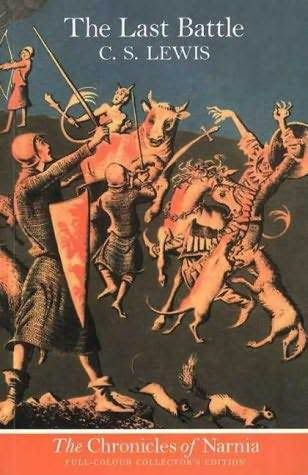
 I just read Neil Gaiman’s "The Problem with Susan," a short story whose title is a play on Lewis’s The Problem of Pain. Susan is a character in Lewis’s beloved Narnia series, while The Problem of Pain is a treatise in which the Christian apologist tries to explain that pain is a good thing because it brings us closer to God. Lewis proposes that God makes us suffer because if we didn’t we would just be these obstinate, free willed beings who would never know the glory of God because we would never need him; therefore, suffering and unspeakable pain are good for our souls. (Not so sure I agree with that premise, Clive. That’s a little too much of “My daddy beats me ‘cause he loves me” school of thought, the kind of conclusion a bewildered, abused child draws to explain why the person who should love and protect him most is brutalizing him. In fact, the more I think about it, that’s some pretty sick shit.)
In both the Chronicles of Narnia and "The Problem of Susan" Susan is an English girl, the oldest child of the Pevensie family. The children are sent from war bombed London to an eccentric relative’s estate to ride out the war. Once at the estate, the children discover a wardrobe that is a portal to Narnia, a magical kingdom populated by talking beasts and figures from Greek, Norse and Arthurian myths and legends. In Narnia, the children find danger and adventure and plenty of Christian allegory. Of course the religious symbolism, as heavy-handed as it is, completely went over my head when I was read the stories, but it still resonated, and I adored the books. The Chronicles of Narnia were and remain the most treasured books from my childhood, and I reread them every couple of years or so with the exception of the horrid Last Battle, the final book in the series.
The book is basically Armagedon for Narnia, and in the course of the book Lewis sadistically destroys everything the reader holds beloved. There is a particularly painful and detailed scene in which the traitorous dwarves shoot arrows into all of the talking, sentient horses, something that was particularly horrible and distressing to me as a child. Even worse, at the end of the book he kills off all of the Pevensie children in a train crash except Susan. The reader is supposed to take some consolation in that although the children die horrifically, they end up in heaven, a place even more glorious than Narnia. Susan, however, is denied and ‘has’ to go on living because she stopped believing in Narnia and became too "too fond of lipsticks and nylons and invitations to parties.” Nice. What kind of message is that? You can be an intolerable brat and be reformed, as in the character of Eustace, or you can betray your family, like Edmund, and redeem yourself, but if you acquire the natural, normal tastes of a your woman then you’re denied heaven? What kind of message is that? Was C.S. Lewis really such a fussy, misogynistic old confirmed bachelor (he wrote these before he married stalker fan Joy Gresham) that the worst sin a person could commit was to like what a normal teenage girl would? I guess you could argue that Susan committed the worst sin by losing her faith that Narnia existed, a chilhood game she has outgrown, but I still think her punishment is harsh and unfair.
The only explanation I can find for the The Last Battle is that C.S. Lewis went completely off his rocker. I have also found the biographical details of his life to be very illuminating, especially his relationship with death. It seems most wounding event of his childhood was the death of his mother when he was a nine. Before he could even begin to process this tragedy, he was sent off when to boarding school, where, in the grand English public school tradition, he was beaten, brutalized and buggered. As a young man he served in the trenches in WWI, where he witnessed first hand the wholesale slaughter of his chums, and after being wounded returned to England to finish up his education at Oxford. He also went on to fulfill a promise he had made to a slain comrade. What follows might explain some of his problems with women.
From The Narnia Skirmishes, a New York Times article by Charles McGrath:
"For more than 40 years, he lived with the mother of a friend named Edward Moore, with whom he had made one of those earnest World War I pacts: if anything happened to either of them, the other would take care of his friend's family. In the event, it was Moore who died, while Lewis came down with trench fever and was later wounded, not severely but badly enough that he was sent home.
The exact nature of their relationship is something that many of Lewis's biographers would prefer to tiptoe around. But Lewis was far from a sexual innocent, and the evidence strongly suggests that, at least until he got religion, there was an erotic component to his life with Minto. Did they actually sleep together, this earnest, scholarly young man, conventional in almost every other way, and a woman 26 years his senior? Walter Hooper, the editor of Lewis's ''Collected Letters,'' thinks it ''not improbable.'' A.N. Wilson, the best and most persuasive of Lewis's biographers, argues that there's no reason at all to think they didn't, leaving us with the baffling and disquieting psychological picture of C.S. Lewis, the great scholar and writer and Christian apologist-to-be, pedaling off on his bicycle, his academic gown flapping in the wind, to have a nooner with Mum. What Lewis saw in Minto is another matter. No one else could stand her. Warnie once described her association with Lewis as ''the rape of J's life.'' He wrote in his diary at the time of her death in January 1951, ''And so ends the mysterious self-imposed slavery in which J has lived for at least 30 years.'' Minto said of Jack, ''He was as good as an extra maid,'' and she subjected him to a kind of domestic slavery that Wilson says he thinks amounted to sexual masochism on Lewis's part. His servility grew worse toward the end of Minto's life, when she slipped into an angry and querulous senility, and he spent most of his waking hours caring for her, for her ancient, incontinent dog, Bruce, and for Warnie, who eventually became a six-bottle-a-day man and was now stumbling around in a stupor all afternoon."
Interesting food for thought relating to Lewis’ problems with death and women. In any case, I love the Chronicles of Narnia enough to forgive C.S. Lewis for The Last Battle. I basically just ignore the book. Neil Gaiman doesn't forgive so easily, however, and The Problem with Susan is an eerie response to Lewis’s idea of God and Christianity as allegorized in Narnia.


No comments:
Post a Comment